
mediNiK®+ SUCTION
Embed stone fragments.
Remove them with suction.
Benefits of using mediNiK® with suction
The mediNiK® hydrogel method enables stone fragments embedded in the hydrogel to be removed using a stone retrieval basket or, as a new option, by suction through a flexible and navigable suction ureteral access sheath (FANS).
Using mediNiK® in combination with suction can achieve:
-
Higher stone-free rate 1
-
Removal of stone fragments even from the lower renal calyx
-
Removal of larger fragments by suction, including fragments larger than 0.5 mm
-
Shorter laser treatment time 2
-
Gentle on the kidney
2 By avoiding additional dusting before hydrogel-assisted fragment removal.
SMASH study
Suction-assisted mediNiK® Application for Stone Harvesting Study
Study type and status
Retrospective, single-center analysis from December 2024 to November 2025.
Completed.
Study objective
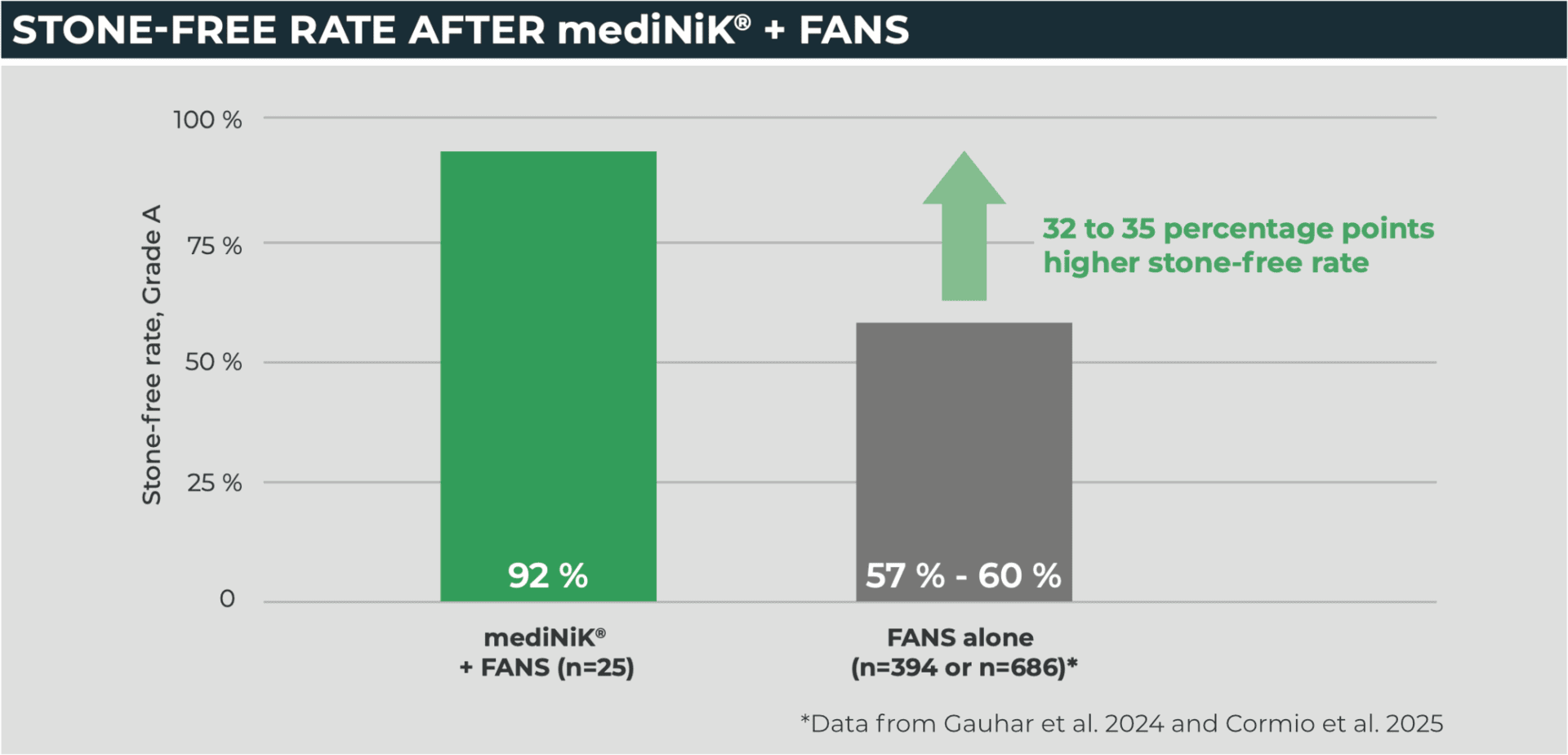
Assessment of the stone-free rate after use of mediNiK® in combination with a flexible and navigable ureteral access sheath with suction (FANS).
Study design
Twenty-five patients with kidney stones underwent retrograde intrarenal surgery (RIRS) using a single-use endoscope, a thulium fiber laser, and mediNiK® in combination with FANS. Stone-free status was assessed by non-contrast computed tomography (NCCT) at least 12 weeks after the intervention. Stone-free grade A is defined as no stones detectable on CT, according to the Journal of Endourology (SAGE Publications. ENR Author Instructions. 2026).
Result

Using mediNiK® with suction
Watch the application video and consult our step-by-step guide to learn how to use mediNiK® with suction. The firmness of the hydrogel can be adapted to the stone burden and instrument diameter by diluting K2.
Before using mediNiK® with suction
A. Prepare the syringes (step 1)
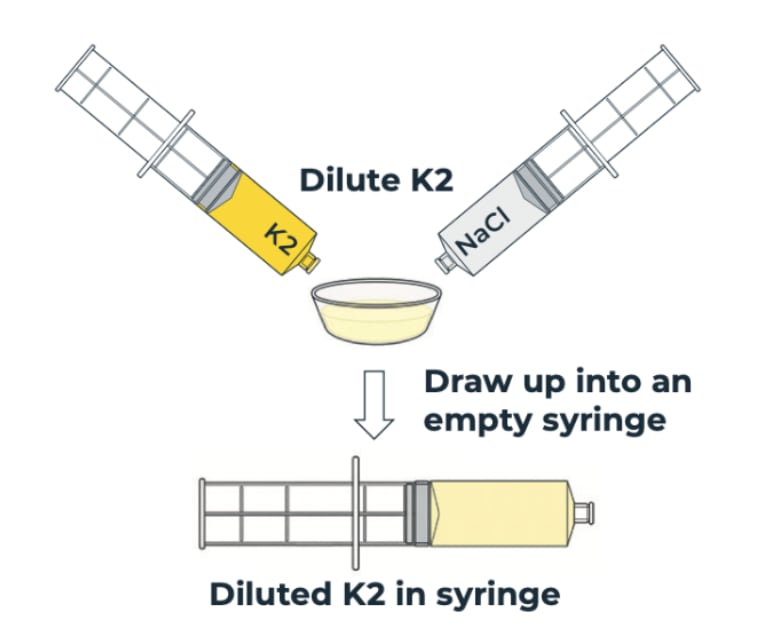
Dilute mediNiK® K2 with 0.9% NaCl. K2 can be mixed with 0.9% sodium chloride solution at volume ratios ranging from 1:1 to 1:4 (K2:saline). Different K2 dilutions produce hydrogel clots of different firmness.
Prepare:
- one syringe containing mediNiK® K1
- one syringe containing diluted K2
- one syringe containing 2 mL of 0.9% NaCl (for step 4)
1:1 dilution of K2
For example, 2.5 mL K2 + 2.5 mL 0.9% NaCl.
- Produces a firmer hydrogel
- Suitable for a lower stone burden
- Suitable for a larger FANS diameter (≥ 13 Fr) and a smaller ureteroscope diameter (≤ 7.5 Fr)
1:4 dilution of K2
For example, 1 mL K2 + 4 mL 0.9% NaCl.
- Produces a softer hydrogel
- Suitable for a higher stone burden
- Suitable for a smaller FANS diameter (≤ 11 Fr) and a larger ureteroscope diameter (≥ 9 Fr)
A 1:4 dilution is recommended for the first use of mediNiK® with FANS.
B. Check the kidney
Ensure that the renal collecting system contains no contrast medium, blood or other substances are present in the kidney that could affect visibility and/or hydrogel formation.
C. Overcome the plunger resistance
Before removing the syringe cap, press the plunger rod to overcome the initial resistance to movement. This helps ensure smooth and uniform emptying of the syringe.
D. Position the stones
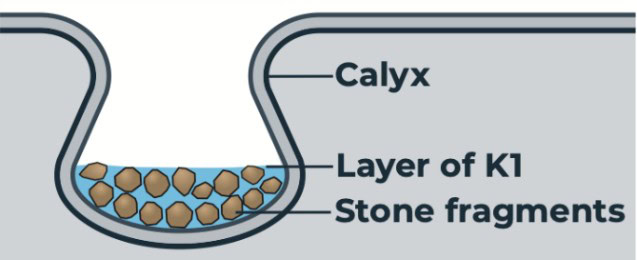
For best results, the stone fragments should be collected at the lowest point of a renal calyx.
Application of mediNiK® with suction
1. Switch off irrigation and suction after lithotripsy
Less is more: in many cases, 1 mL of K1 is enough to cover the fragments.
3. Carefully apply 1–2 mL of 0.9% NaCl through the working channel
This step flushes any remaining K1 out of the working channel.
In many cases, 3–5 mL of diluted K2 is sufficient.
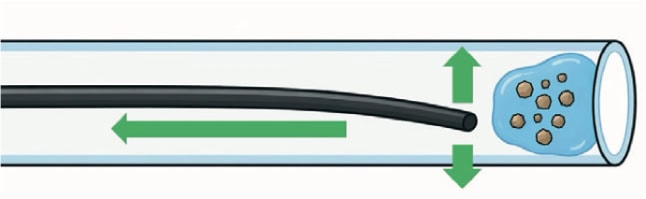
5. Switch on irrigation and suction to remove the hydrogel clot
To facilitate removal, move the suction sheath back and forth and up and down. Then slowly withdraw the ureterorenoscope.
After application
Ensure that all hydrogel clots have been removed. Any remaining hydrogel clots will generally dissolve as a result of diuresis. The hydrogel can also be actively dissolved by adding a chelating agent (e.g. EDTA).
Repeating the procedure: If the procedure is repeated, all of the previously used yellow K2 must be completely flushed out of the kidney.
Single use: mediNiK® is intended for single use and must not be resterilized.
Disposal: Syringes containing blue K1 and yellow K2 can be disposed of according to the least restrictive internal hospital disposal standards. The hydrogel must be disposed of separately because it has come into contact with mucous membranes and/or urine.
 Notice
Any serious incident occurring in connection with the product must be reported to the manufacturer and the competent authority of the Member State in which the user and/or patient is established (vigilanz@purenum.com).